
Governance, Risk management, Strategy, Sustainability

Why strong ESG governance remains important for business

19 January 2026  —  3 minutes reading time

For some organisations, the ESG backlash has been destabilising. For others, it has stripped things back to what actually mattered.

Quite a few companies are quietly stepping back from sustainability commitments. Others continue with relatively little disruption. The difference has turned out to be less about ESG itself, and more about how governance was structured from the start.

Where ESG was built as a communications-led programme: ambitious targets, public commitments, limited board oversight, it has proven fragile.

In organisations that embedded environmental and social risks into existing governance, very little has actually changed.

That distinction matters more than the politics surrounding ESG.
The backlash as a governance filter

In organisations where sustainability sat at the edges — owned by small teams, disconnected from risk management and resource allocation — pressure exposed weak foundations. When investor enthusiasm cooled or political scrutiny increased, scaling back became a rational response.

In organisations where governance was built differently, the backlash has had far less impact. Board oversight remained in place. Operational accountability did not disappear. Decisions continued to be made through established processes.

What changed was not the relevance of environmental and social risks, but the tolerance for performative structures that never governed them properly.

“In practice, the pushback against ESG hasn’t reversed much. It has mostly revealed which governance structures were real, and which never were.”

What held, and what didn’t ?

No real surprises here, the patterns are familiar.

What tended to unravel:

  • ESG framed primarily as external positioning
  • Reporting volume increasing without influencing decisions
  • Metrics proliferating without clarity on what was actually material
  • Sustainability teams held responsible for outcomes they never had the authority to control

What largely held:

  • Environmental and social risks embedded in enterprise risk management
  • Board oversight through existing risk or audit structures
  • Procurement and operations managing supply-chain risks as part of business-as-usual
  • Finance involved in prioritisation and resource allocation

Clearly not a question of ambition, simply an outcome of design decisions.

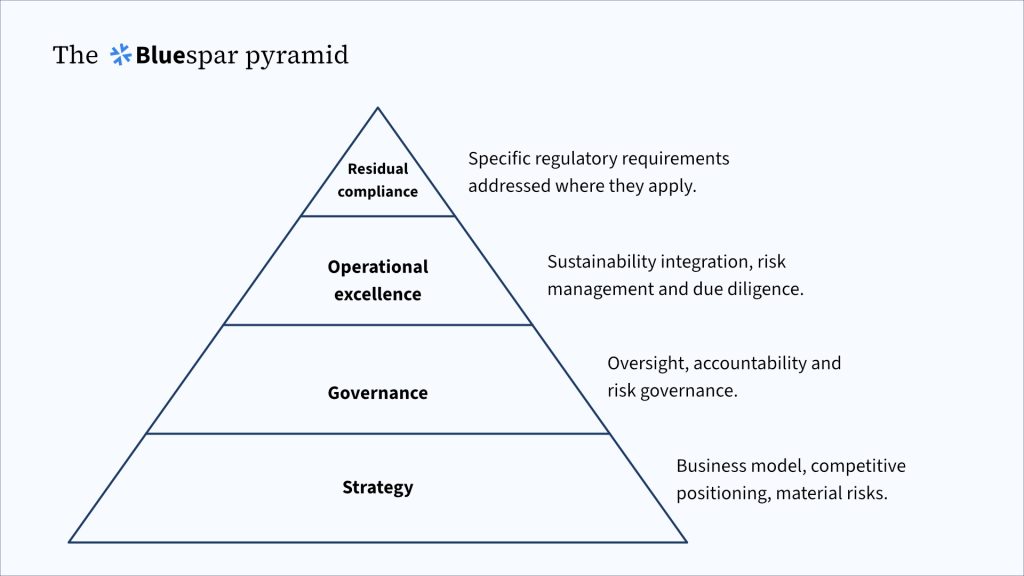
Picture of a pyramid, foundation is strategy, next layer is governance, third layer is operational excellence, final layer is residual governance


The capabilities that still earn their keep

For organisations that built governance rather than programmes, several capabilities continue to justify themselves — regardless of how ESG is discussed publicly.


Early risk visibility and escalation

Environmental and social risks still disrupt operations, delay projects, and affect supply continuity. Companies that can identify these risks early, and escalate them through clear governance channels, respond faster and more proportionately than those caught by surprise.

Operational integration instead of parallel systems

Where environmental and social considerations are embedded into procurement, risk management, and operations, overhead remains contained. Where parallel sustainability systems exist, duplication persists — data collected twice, assessments repeated, supplier engagement fragmented. Integration is not ideological; it is cost discipline.

Regulatory absorption without crisis

Regulation continues to evolve. Companies with mature governance absorb new requirements through existing structures. Those without foundations tend to respond through emergency programmes, external support, and rising costs. Regulation does not create the need for governance; it reveals whether it already exists.

These capabilities do not depend on ESG narratives. They earn their place because they support operational continuity and decision-making.


This is not about ESG as a label

Boards have always been responsible for risk oversight, strategic direction, and stakeholder relationships.

What has changed is which risks and dependencies materially affect business outcomes, and how visible those impacts have become.

For organisations that embedded these risks into governance early, the debate about ESG terminology is largely secondary. The systems remain useful regardless of what they are called.

“ESG as a term may have become politically contested. Governance of material environmental and social risks has not.”

The questions boards are actually asking now

In many boardrooms, we see that the conversation is shifting away from defence and toward focus.

Which environmental and social issues are genuinely material to our business model?
Not everything labelled ESG matters equally. Clarity on materiality enables proportionate investment and focus of resources.

Where does this strengthen existing systems?
The question is not whether to build new ESG infrastructure, but whether environmental and social risks belong in existing risk management, procurement, and oversight processes.

Are we building capability or managing perception?
Capabilities endure under pressure. Perception management does not.

These are governance questions, not sustainability slogans.

What really matters

The organisations navigating this moment most effectively did not build ESG programmes. They built governance systems that manage real risks, allocate responsibility clearly, and support sound decisions.

Sustainability outcomes emerged from those systems as a consequence, not a promise.

As sentiment shifts, those foundations continue to earn their keep — quietly, and largely unaffected by the debate around ESG itself.

That is the difference that matters now.


How we support organisations

Our work focuses on exactly these governance foundations: clarifying which environmental and social risks are genuinely material, embedding them into existing risk, procurement and governance structures, and building capability where accountability already sits.

We work with boards and senior teams who are less interested in ESG narratives than in governance that functions under pressure. Because that is what ultimately protects performance, trust, and decision-making.

Schedule a brief consultation

Your time is valuable. Book a brief consultation to explore how Bluespar can support your strategic sustainability goals and together determine the next steps. A focused 15-minute call can provide the clarity and direction needed to move forward.