Governance, Strategy

Sustainability decisions: strategy, not reporting

21 January 2026  —  4 minutes reading time

Sustainability has this habit of resurfacing at board level.

Not as a reporting issue, but in the context of decisions about investment, commercial partnerships, market access, cost exposure, or long-term risk. This also happens when sustainability policies exist, reports are published, and controls appear to be in place.

When that moment arrives, the response is frequently technical. Attention turns to data quality, reporting scope, governance frameworks, or whether something has been missed in existing processes.

In many cases, that reaction actually misdiagnoses the problem.

Sustainability tends to return to the board not because reporting has failed, but because a strategic choice is being tested.

Reporting helps explain how the organisation has performed. It provides transparency and supports accountability. Over time, it also allows comparison. Those functions matter, particularly in environments shaped by regulatory scrutiny and external expectations.

But reporting is necessarily backward-looking. It describes outcomes after decisions have already been taken.

Strategy operates in the opposite direction. It shapes where the organisation places itself, which dependencies it accepts, and which trade-offs it is prepared to live with over time. Those choices determine exposure long before performance is measured.

Many sustainability-related issues land exactly there. They involve uncertainty, long horizons, and competing priorities. They arise through decisions about sourcing models, capital allocation, growth markets, or operational dependencies.

Disclosure can inform decisions. It doesn’t take them.

How sustainability enters strategy; often without being named

In practice, sustainability rarely appears on board agendas under its own heading. It shows up as cost volatility linked to energy use, raw materials, or logistics dependencies. It surfaces through supply disruptions connected to labour conditions, environmental stress, or regulatory intervention. It appears in discussions about licence to operate, workforce stability, reputational exposure, or access to markets and capital.

In many organisations, these topics are first treated as commercial or operational concerns. Only later are they grouped together and described as sustainability.

By that stage, the strategic tension already exists. A choice still has to be made, and the consequences of that choice will persist.

This is why sustainability can feel as though it is gradually encroaching on strategy. In reality, it has been present all along, embedded in decisions about continuity, resilience, and long-term positioning.

When impact turns into financial risk faster than expected

One reason these issues increasingly reach board level is that the distance between impact and financial consequence has narrowed.

Environmental degradation, labour conditions, or community relations were once treated as external or long-term considerations.

Today, they can translate into operational disruption, regulatory intervention, litigation, or investor response far more quickly than many organisations expect.

What started as an impact concern does not always remain abstract. Boards no longer have the luxury of assuming that these effects will stay peripheral to core business decisions.


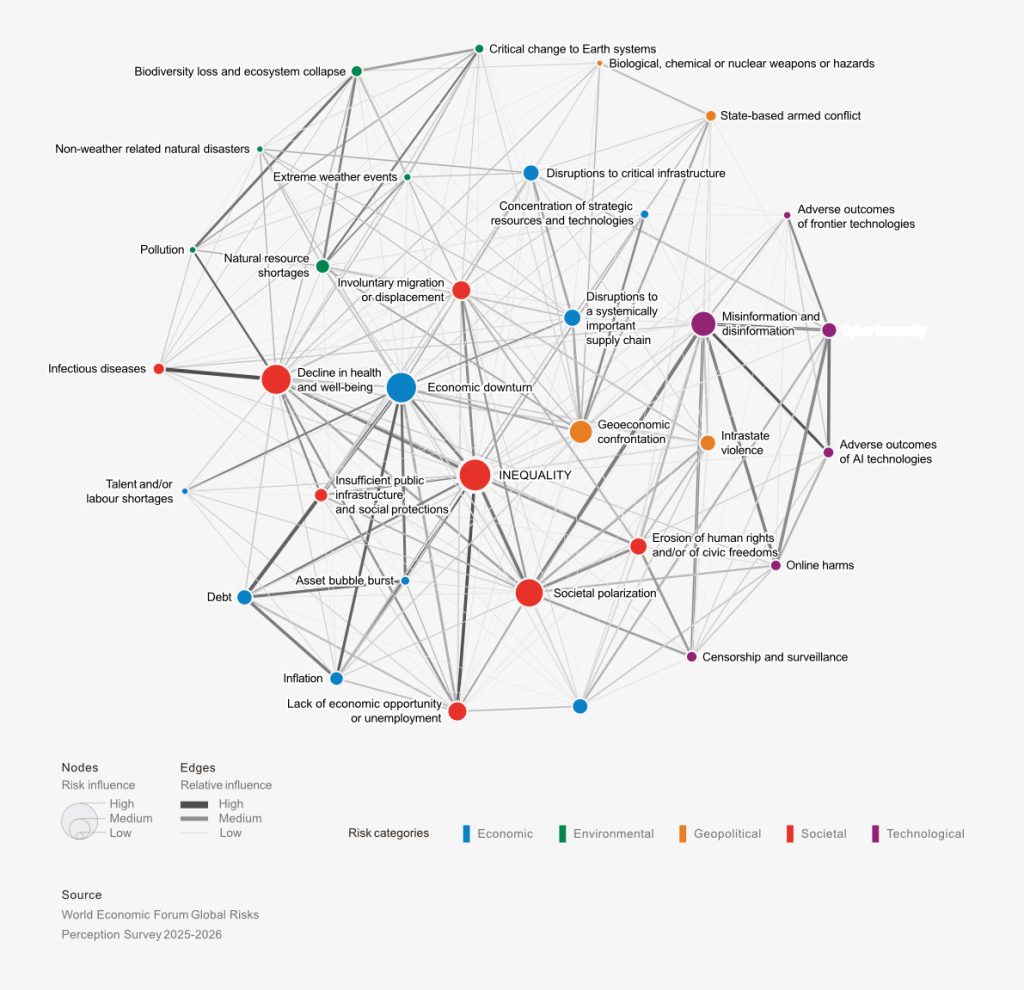
WEF 2026 risk map showing interconnections

World Economic Forum Globals Risks 2026


The real governance problem is not ambition

When sustainability-related issues start to challenge strategic assumptions, many organisations struggle to place them.

Historically, sustainability has often been positioned downstream of strategy, linked to reporting, compliance, or specialist functions. That approach was workable when expectations centred on disclosure and policy alignment.
It becomes strained when sustainability-related considerations begin to shape strategic choices.

At that point, familiar governance arrangements offer limited guidance. Decisions cut across functions, time horizons, and risk categories. Responsibility is diffuse, and escalation paths are unclear.

Boards often encounter this discomfort late in the process, when options have narrowed and trade-offs have become harder to reverse. The unease that follows is frequently attributed to sustainability itself, rather than to the absence of a clear place for these decisions to sit.

Creating separate sustainability governance structures rarely resolves that tension.

More often, it fragments accountability and pushes decisions further away from existing oversight mechanisms. The challenge is integration: ensuring that sustainability-related risks, impacts, and opportunities are considered where strategic decisions are already taken, using the governance structures that already carry authority.

What changes when sustainability is treated as strategic dimension

When sustainability is recognised as part of strategy rather than as an extension of reporting, a number of shifts tend to follow.

Issues surface earlier, while options are still open and choices remain reversible. Trade-offs are addressed deliberately rather than deferred until external pressure forces a response. Responsibility becomes clearer because decisions sit with those who already have the mandate to make them.

None of this requires new committees or additional layers of oversight.

It requires clarity about when sustainability-related considerations enter strategic discussions and how they are handled once they do.

Capability, not structure, is often the limiting factor

Where organisations struggle with this shift, the obstacle is rarely conceptual; it usually is much more practical.

Recognising sustainability-related trade-offs, discussing them constructively, and acting on them within existing decision-making processes requires experience and confidence. It requires boards and executives to engage with uncertainty and accept that not every dimension of a decision can be optimised simultaneously.

This can feel uncomfortable at senior level. Long-term exposure is harder to debate than short-term performance, particularly when familiar financial metrics offer limited guidance. Organisations that build this capability do not necessarily change their governance. They change how decisions are framed, what information is treated as relevant, and how responsibility is assigned when trade-offs emerge.

What this really asks of governance

When sustainability keeps returning to the board agenda, the problem is rarely that something was missed in reporting.

More often, it is a signal that strategic decisions are being tested — without clear agreement on who decides, how sustainability considerations should weigh in, or when issues should escalate.

And if you recognise this, are you ready to let your governance reflect it?

Schedule a brief consultation

Your time is valuable. Book a brief consultation to explore how Bluespar can support your strategic sustainability goals and together determine the next steps. A focused 15-minute call can provide the clarity and direction needed to move forward.