Why transportation, warehousing and distribution remain under-examined in human rights due diligence
When labour exploitation surfaces in European supply chains, procurement teams are often surprised by where it appears.
Not in distant production facilities, but in parking areas outside distribution centres.
Not with unknown suppliers, but with logistics providers they have worked with for years.
Increasingly, it also surfaces inside distribution centres themselves — in subcontracted warehouses that companies rely on every day, yet seldom associate with human rights risk.
These cases rarely emerge through internal human rights due diligence systems. More often, they come to light through labour inspections, union action, court cases, or investigative journalism — close to home, in ports, roadside rest areas, rail terminals, inland waterways and logistics hubs that companies depend on to keep goods moving.
When this happens, escalation is swift. Not only because the issue appears closer to home than expected, but because it is often encountered first through the press.
Part of the explanation lies in where most due diligence still focuses.
When companies assess human rights and environmental risks in their supply chains, attention usually settles on where products are made or raw materials extracted. Factories, farms and mines are mapped, audited and monitored in increasing detail.
Meanwhile, an entire workforce keeps those supply chains moving.
Millions of people transport goods across oceans, rivers, railways and roads. For most companies, these activities are operationally critical but not core business. As a result, labour conditions in transportation, warehousing and distribution often remain outside the scope of formal human rights due diligence — despite extensive evidence of adverse impacts in logistics.
The issue is not a lack of standards or awareness. It is that most due-diligence systems were designed around fixed workplaces. Transportation, warehousing and distribution sit just outside that frame.
Share article:
Why logistics risks fall outside the frame
Transportation work is mobile, transnational and frequently organised through layered subcontracting arrangements. Workers cross borders as a matter of routine. Employment relationships fragment across logistics providers, agents and labour recruiters. Enforcement depends on national authorities with differing capacity and priorities.
Commercial logistics relationships focus on price, capacity and delivery performance. Labour conditions are often assumed to sit further down the chain, outside the immediate contractual relationship.
None of this makes transportation exceptional. It just explains why risks rarely surface through factory-centric due-diligence systems. Until an external actor forces them into view.
Scale without visibility
The scale of global logistics labour makes this blind spot consequential rather than marginal.
For many workers, conditions are well regulated. For others, vulnerabilities are significant. Long periods away from home, reliance on intermediaries, migration status and sustained cost pressure increase exposure to exploitation.
The COVID-19 pandemic made this visible at scale. At its peak, hundreds of thousands of seafarers were stranded on ships beyond their contracts when crew changes were denied. At the same time, truck drivers faced surging demand, longer hours and deteriorating conditions.
The episode was exceptional in scale, but not in nature. It amplified and exposed risks that already existed — and that, after the pandemic, still continue in less visible forms.
“Over 100 million people worldwide move approximately 80–90% of global trade by volume.”
Different modes, different risk profiles
Visibility varies not only by company, but by transport mode.
Human rights risks in logistics differ significantly by transport mode, with maritime, road, rail and inland waterway transport each presenting distinct vulnerability patterns.
In maritime transport, global operations intersect with fragmented governance.
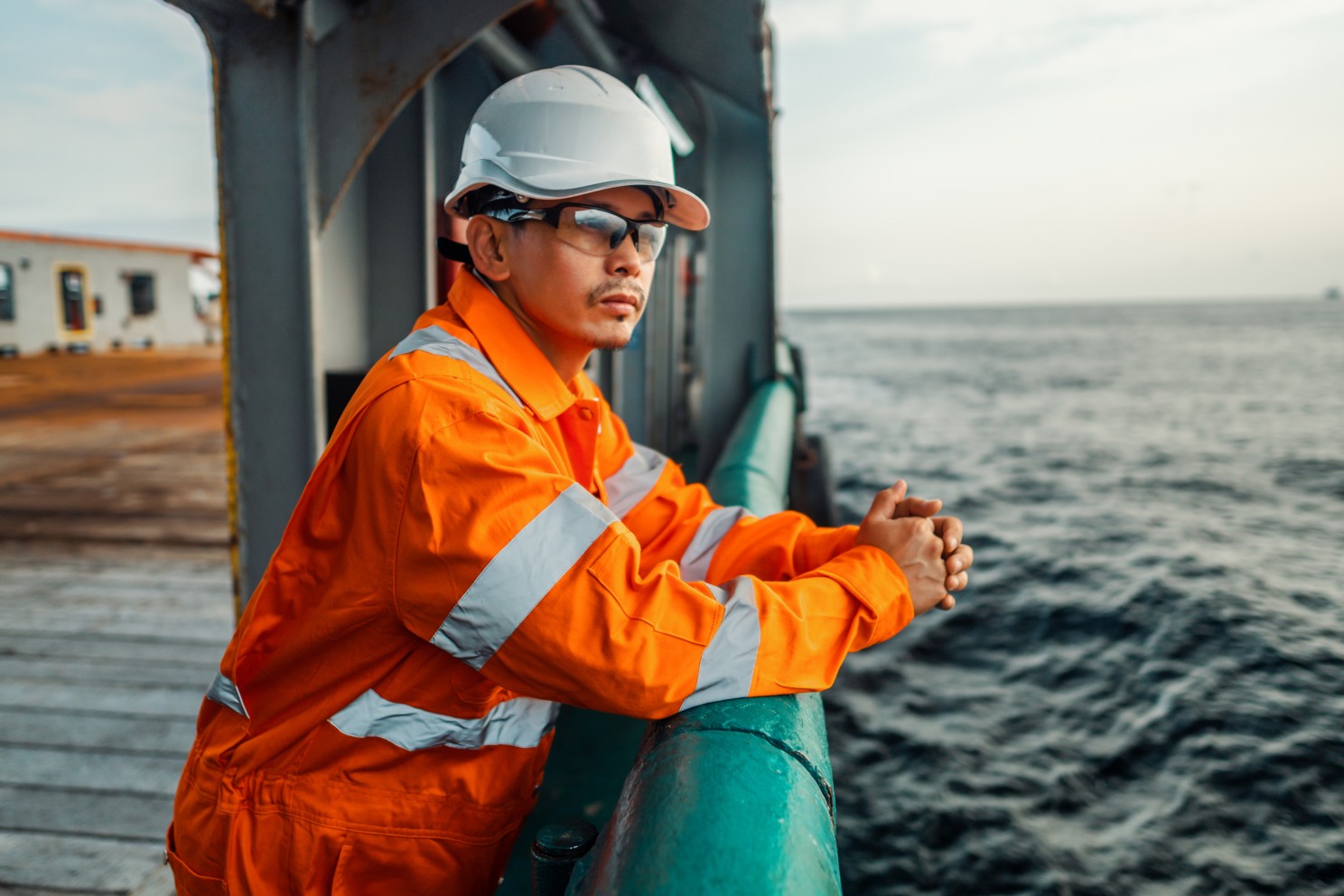
Seafarers may work under flags unrelated to their nationality, employed by companies headquartered elsewhere and recruited through agencies in yet another country. Excessive contract lengths, delayed wages, abandonment, unsafe conditions and recruitment abuses remain persistent risks. International standards exist, but enforcement varies widely.
Road transport has become one of the most visible areas of labour abuse in Europe.
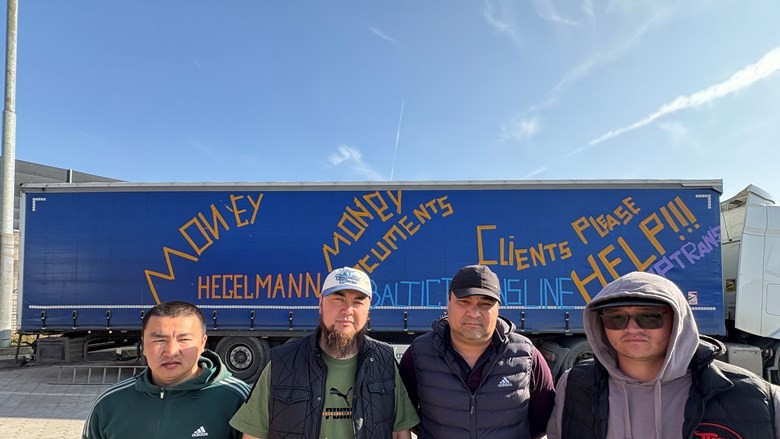
Central Asian truck drivers on strike at a parking lot in Venlo. Image credit: FNV
Investigations have revealed systemic exploitation of migrant drivers through complex subcontracting structures. Underpayment, excessive hours, degrading living conditions and, in severe cases, forced-labour indicators are well documented.
Formal rules exist, but enforcement gaps and commercial pressure continue to shape outcomes.
Rail freight is generally better regulated, yet not immune.
Workforce shortages, outsourcing of maintenance and terminal operations, and efficiency pressure increase fatigue and safety risks. Unionisation provides a degree of protection, but restructuring continues to test established arrangements.
Inland waterway transport operates at smaller scale, but with its own vulnerabilities.
Crews often live and work on vessels for extended periods. Migrant labour is common, social-protection coverage can be unclear, and isolation is a recurring concern.
Family-owned operations often manage these issues relatively well; risks tend to concentrate in larger commercial structures.
Where issues also surface: warehouses and distribution centres
Warehouses and distribution centres are often assumed to be covered by existing due diligence because they are fixed sites.
In practice, they are frequently where logistics-related risks first become visible.
Drivers wait for hours without access to basic facilities. Turnaround pressure overrides working-time rules. Responsibility for conditions at a site is diffuse: the warehouse operator, logistics provider and contracting company may each assume someone else is accountable.
Distribution centres also deserve attention as labour environments in their own right. Operations are often subcontracted, with workers hired through agencies on short-term or rolling contracts. On paper, these sites appear covered. In reality, they often fall between logistics reviews and workplace audits.
Problems are not hidden.
They are simply not owned.
Last-mile delivery and platform work: another very visible blind spot
The growth of e-commerce has added a layer to logistics that is both highly visible and poorly captured by traditional due-diligence approaches.
Last-mile delivery increasingly relies on platform-mediated or gig-based work. Couriers are often classified as self-employed, paid per delivery, and managed through algorithmic systems that set routes, performance metrics and incentives. Responsibility for working conditions is diffused across platforms, subcontractors and individual workers, even as commercial pressure for speed and low cost intensifies.
From a due-diligence perspective, this reproduces familiar challenges in compressed form. Employment relationships fragment. Audits have little reach. Worker turnover is high. And fear of de-activation or income loss discourages workers from raising concerns openly — until issues surface through strikes, media coverage or public campaigns.
These risks sit at the consumer-facing end of highly optimised supply chains. Yet last-mile delivery is often treated as a service interface rather than as part of the supply chain where labour risk is generated.
Where companies begin to engage with this reality, the same questions apply as elsewhere in logistics: how pricing and delivery promises translate into pressure on workers, where responsibility sits across contracting structures, and how worker voice can function in contexts where speaking up carries immediate consequences.
Why factory-style due diligence falls short
Across long-haul transport, warehouses and last-mile delivery alike, the common thread is not the type of work, but the way responsibility fragments as supply chains become faster, more outsourced and more data-driven.
At this point, the limits of factory-style due diligence become visible.
Traditional factory-focused due diligence assumes fixed workplaces, identifiable employers and stable jurisdictional boundaries — assumptions that do not hold for mobile transportation workforces.
Audits struggle to capture recruitment practices several steps removed from contractual relationships.
Supplier questionnaires rarely reflect mobile working realities.
Risk mapping often stops at tier-one logistics providers, missing labour conditions further downstream.
The result is perceived coverage that does not always match reality.
What changes when logistics is taken seriously
Closing this gap does not require separate compliance programmes. It requires adjusting how existing due diligence is applied. In practice, organisations that start to close this gap rarely do so by adding another layer of policy or audit.
The shift is more basic.
Transportation is made explicit in risk assessments rather than assumed to be covered indirectly. Contracts begin to reflect how work is actually organised, not just what standards exist on paper. Monitoring moves closer to recruitment practices, working-time and pay records, and conditions at delivery points, rather than relying on site visits alone.
This also most likely means enabling worker voice that works for mobile and subcontracted workforces — often through scalable digital channels that allow concerns to be raised anonymously and across borders and employment arrangements. Commercial decisions on pricing, scheduling and capacity can then be examined for how they translate into pressure on labour further down the chain, so that workers who are rarely seen, and often reluctant to speak up, still have a safe way to be heard.
None of this reinvents due diligence; it just brings existing approaches closer to operational reality.
Final thoughts
Extending human rights due diligence into logistics is not about adding complexity. It is about aligning existing approaches with how supply chains actually function — and recognising that resilience, continuity and responsibility are closely connected.
Transportation and distribution happen in plain sight. At sites companies use daily and along routes that keep goods moving.
The issue is rarely a lack of standards or information. It is that some of the most operationally critical parts of supply chains sit just outside the areas where traditional due diligence was designed to look.
When that gap closes, fewer issues surface as surprises. And responsibility becomes easier to locate — not because supply chains are simpler, but because attention is directed where risk actually concentrates.
About the author
Peter Suasso de Lima de Prado is Managing Director of Bluespar. He has over 25 years of experience in global supply chains and logistics, including senior leadership roles at a major European steel producer, where he served as Global Head of Freight, Head of Logistics Sourcing, and Head of Sustainability. His work focuses on integrating sustainability, human rights due diligence and risk management into strategy and operational decision-making, grounded in firsthand experience of complex international logistics and procurement environments.
Get our latest ESG updates, trends, and insights delivered monthly. Sign up to stay updated on key ESG developments and equip yourself with relevant information to make informed decisions.
Your time is valuable. Book a brief consultation to explore how Bluespar can support your strategic sustainability goals and together determine the next steps. A focused 15-minute call can provide the clarity and direction needed to move forward.


 More insights